

TradeStation has joined the Hubfinance platform, bringing more than four decades of experience at the intersection of trading technology and brokerage services. Serving traders and institutions across equities, options, futures, commodities and ETFs, the group combines electronic market access with customisable infrastructure designed to support complex trading workflows.
Today, Hubfinance speaks with William Skultety, CFA CMT, Executive Director / COO of TradeStation Europe, about the firm's development across Europe and the evolving needs of family offices, private banks and asset managers.
From research and backtesting to execution, clearing and reporting, he explains how a connected trading infrastructure can support investment implementation, improve operational visibility and give European firms greater control over their U.S. market activity.
From U.S.-markets pioneer to European institutional broker, how would you describe TradeStation's DNA as you build out your footprint across Europe?
TradeStation's DNA extends beyond execution to the complete trading workflow. For more than four decades, the group has combined trading technology with U.S. brokerage infrastructure for active and technically sophisticated market participants.
TradeStation Europe brings that heritage to European clients through a Dutch-regulated financial firm in Amsterdam, supported by a high-touch concierge service for onboarding, technology implementation and day-to-day operational coordination.
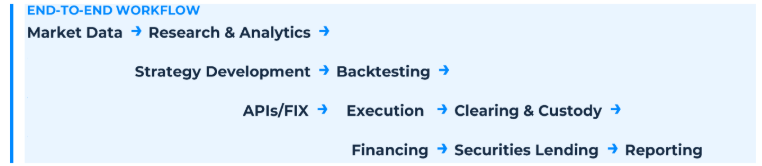
Clients will not all use those capabilities in the same way. Some will work through TradeStation's platforms, while others will connect their own systems (EMS/OMS) through APIs, FIX protocol, or appropriate institutional connectivity. The aim is to support more of the workflow through one specialist ecosystem, with fewer handoffs, better visibility and clearer ownership.
Our ambition is to become the strategic broker of choice for European firms who want greater control over how they research, implement and manage their U.S. market activity.
Institutional-grade access used to be reserved for institutions. Are family offices now expecting, and getting, the same level of capability?
Increasingly, yes. Institutional capability is no longer synonymous with institutional scale.
A family office can now access advanced market data, professional analytics, APIs, listed derivatives and execution controls without first recreating the infrastructure of a large bank or asset manager.
TradeStation can bring those capabilities together while fitting around the custodians, portfolio systems and governance processes the family office already uses. This gives the investment team access to institution-class tools without requiring every element of the operating model to be built internally.
The technology, however, is only part of the equation. Appropriate permissions, risk controls, and operational oversight remain essential. Different family offices will also require different solutions. An office managing concentrated public-equity positions may prioritise options and hedging tools, while one running systematic strategies may place greater value on data, backtesting and connectivity.
The opportunity is not to imitate a much larger institution. It is to use the same calibre of capabilities where they improve investment implementation, while keeping the infrastructure proportionate to the family office's actual needs.
Electronic market access, self-clearing and institutional-grade infrastructure: what does that actually change for family offices and wealth managers seeking more control and transparency?
The practical change is a shorter distance between the trading decision and the infrastructure that supports it.
For clients, the value lies in connecting execution more closely with order, position, account, margin and reporting information. That can provide better visibility into what has happened, what capital is being used and what action may be required next. It can also reduce the operational friction created when data and responsibilities are divided among separate systems and providers.
Electronic market access and self-clearing are therefore not simply infrastructure labels. Their relevance lies in creating a more connected, transparent and manageable trading process.
Futures, listed options and quantitative strategies remain underused by many European investors. How do these capabilities fit into modern wealth management, from hedging to diversification?
These capabilities matter because they allow sophisticated investors to manage risk and implement investment ideas with greater precision.
A family office can use market data and analytics to model an options hedge around a concentrated equity position before committing capital. An asset manager can test how a futures overlay might alter portfolio exposure under different market conditions. A quantitative investor can translate an investment hypothesis into explicit rules, backtest those rules, and connect the resulting strategy to an execution workflow.
TradeStation supports that progression through market data, research, analytical tools, backtesting, trading platforms, and APIs/FIX connectivity. Once a strategy is live, the wider ecosystem can support execution, margin, position visibility, clearing, financing and securities lending.
TradeStation's value then is not simply making futures, options and quantitative tools available. It is helping clients move from an investment idea to a tested, executable and manageable strategy within a connected workflow.
By joining Hubfinance, what conversation does TradeStation want to start with private banks, multi-family offices and asset managers about the future of U.S. market access?
Most private banks, multi-family offices and asset managers can access U.S. markets in some form. The more useful question is where the existing model still creates friction. That may involve listed-derivatives access, quantitative implementation, data and connectivity, financing, securities lending, reporting or operational ownership.
We want to contribute TradeStation's experience in U.S. markets, while learning how those challenges present themselves across different European institutions. For one firm, the answer may be an additional execution relationship. For another, it may be API integration, specialist derivatives capability or more direct operational support.
We are not suggesting that every organisation should replace its existing custodians, portfolio systems or broker relationships. TradeStation can operate alongside that architecture where a specialist U.S.-markets ecosystem can close a defined gap or connect parts of the workflow more effectively.
That is the conversation we want to develop through Hubfinance: how firms can turn U.S. market access from a standalone service into a better-supported part of their investment operating model.
For more information, please contact +31 20 214 0479 or ctemo@tradestation.eu